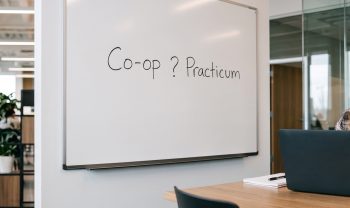



Practicum and co-op get used as though they mean the same thing, and in casual conversation people swap them freely. They are not the same thing. They differ in length, in whether you are paid, and in what the placement is designed to demonstrate. Since that difference can be the deciding factor between two programs, it is worth being precise about.
Here is how the two work at Brighton, which programs carry which, and what the process genuinely involves, including the parts that are less comfortable to say out loud.
Practicum: Short, Unpaid, Focused
A practicum is a short unpaid placement attached to a program. At Brighton these run about 4 weeks, and in some programs they are optional rather than required.
The purpose is exposure and application. You take skills that have only ever been used in a classroom and use them in a workplace where the pace, the interruptions and the consequences are real. Four weeks is enough to learn how a department actually operates, to find out whether you enjoy the environment, and to leave with a named employer on your resume and someone who can speak to how you worked.
What four weeks is not is enough time to be handed significant independent responsibility. Treat it as a well supervised trial rather than a job.
Co-op: Paid, Longer, Closer to a Real Job
Co-op placements at Brighton are paid, and they are longer, ranging from 4 to 32 weeks depending on the program. You are a working member of a team, paid for the work, and expected to perform accordingly.
The employer relationship is different because of that. An unpaid practicum student is a guest the workplace is hosting. A paid co-op student is on the payroll, which changes what gets delegated to you, how directly you are managed, and how honestly you are given feedback. That shift is uncomfortable at first and it is the whole point.
What Length Changes About What You Learn
Length is not a minor variable. Four weeks teaches you what the work looks like. Twelve weeks teaches you to do it under normal conditions, because you are there long enough to see a full cycle and be trusted with something that matters. Thirty-two weeks teaches you the parts of the job nobody documents: how decisions actually get made, how the busy season differs from the quiet one, which relationships hold the place together.
A longer placement also produces a stronger reference, because your supervisor has watched you long enough to say something specific.
Which Brighton Programs Carry Which
Practicums appear in the International Trade and Freight Forwarding Certificate (26 weeks with a 4 week practicum), the freight forwarding diploma (42 weeks with a 6 week practicum), the Computerized Accounting and Office Certificate (34 weeks with a 4 week practicum), and the Hospitality Operations Certificate (25 weeks with a 4 week practicum of 100 hours). The AutoCAD drafting and design certificate offers an optional 4 week practicum of 150 hours, taking the program from 31 to 35 weeks.
Co-ops appear in the longer credentials: the Business Management Diploma (49 weeks with a 12 week co-op), the Hospitality Management Diploma (48 weeks with a 12 week co-op), and the Hospitality Management with Co-op Diploma (72 weeks with a 32 week co-op).
Some programs carry neither. The Construction Estimating and Project Scheduling Certificate is 14 weeks with no practicum, and the International Trade Certificate is 16 weeks. If workplace experience is a priority for you, check this on the outline rather than assuming.
The Part Worth Saying Plainly
Placement is not guaranteed. Not at Brighton and not, honestly, at any school that describes its process accurately.
Here is what actually happens. Students interview with host employers, and the employer decides. Students are encouraged to help find placements, and the ones who use their own contacts and approach employers directly often land better matches than those who wait. Career services assists throughout, and Brighton’s career centre supports job search alongside the placement process, with employment coordinators helping with resumes and portfolios near graduation.
Read that as reassuring rather than discouraging. A program that promised you a placement would be promising something it does not control. What a school can offer is preparation, employer relationships and support, and those are worth asking specific questions about.
The Practical Requirements
A few logistics catch people by surprise, so plan for them early. Both parties sign a WEP Application and Conditions document that sets out expectations before a placement begins. Students arrange their own transportation to and from the placement, which is worth thinking about when a good opportunity sits outside your usual commute. Criminal record checks are required for work involving children or vulnerable adults, and those take time to process, so start early if your field touches that.
Brighton’s Work Experience Program page sets out the conditions in full, and it is worth reading before you enroll rather than in the week your placement is being arranged.
One Last Thing
If workplace experience is the reason you are retraining, let it drive the program choice rather than treating it as a bonus feature. Ask which programs include it, how long it runs, whether it is paid, and what the school does when a placement is difficult to find. Those four questions will sort your shortlist quickly.
Work experience is structured differently from one program to the next. Ask below about the one you are weighing, name it, and the answer will be specific too.