There is a question people rarely ask out loud in a room full of others and almost always ask privately afterward, sometimes years later: am I going to be found out because I was bad at math in school?
It is a fair worry and deserves a real answer rather than a pep talk. The short version: the math used in drafting and estimating is not the math most people struggled with, software handles much of the calculation, and numeracy still matters, in a different way than school suggested.
The Math That Actually Shows Up
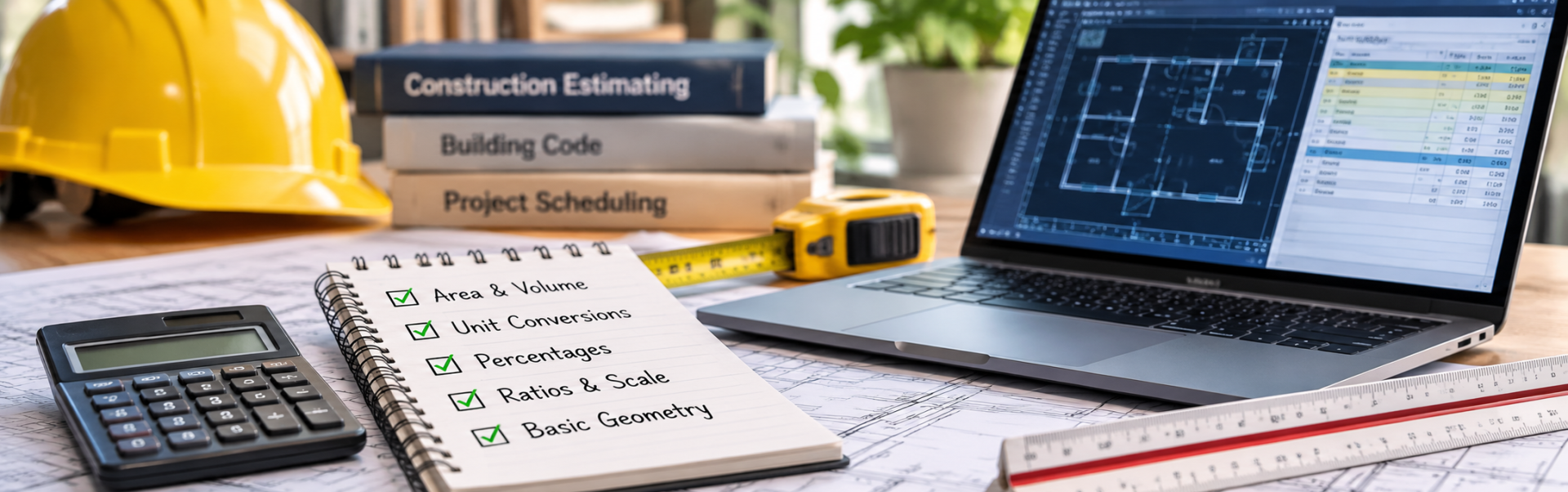
Look at what these jobs use day to day and the list is fairly short. Arithmetic, constantly. Percentages, for markup, overhead, contingency and waste factors. Ratios and proportion, which is what a drawing scale is. Unit conversion, between metric and imperial and between the units a supplier quotes in and the units your takeoff is in. Area and volume, for everything from flooring to concrete. Basic geometry and angles, for setting out and for understanding how a roof or a stair works. And reading a scale, on paper or on screen.
That is genuinely most of it. It is practical, repetitive math applied to physical things, and the same handful of operations come up again and again until they stop feeling like math at all.
What You Are Probably Remembering Instead
When people say they are bad at math, they are usually remembering algebra with letters in it, trigonometric identities, proofs, or calculus. Those are abstract subjects taught abstractly, and struggling with them says very little about whether you can work out how many square metres of drywall are on a floor plan.
The conditions differ too. School math was timed, solitary, and scored on getting one answer without help. Estimating is done with a computer in front of you, checked by other people, and judged on whether the finished number is defensible. Plenty of people who were poor at the first are good at the second.
Where the Software Carries the Load
Modern tools do the arithmetic. In AutoCAD you draw or model to real dimensions and the software reports lengths, areas and volumes; you are not calculating them by hand. Digital takeoff tools tally quantities as you trace them. Estimating software applies unit rates and totals the bid. Spreadsheets do the multiplication and the percentages, and scheduling software calculates dates, durations and float.
What you have to be able to do is set the thing up correctly and read the result. That means knowing which units you are working in, structuring a spreadsheet so the formulas make sense, and understanding what a number represents. The mechanics are handled. The meaning is not.
Where Numeracy Still Genuinely Matters
Here is the honest part. There are three places where being comfortable with numbers matters a great deal, and none of them are about calculation speed.
The first is noticing when an answer is obviously wrong. If the software says a residential bathroom floor is 400 square metres, someone has drawn something in the wrong units or traced the wrong boundary. That error only gets caught by a person with a rough sense of what the right answer should look like, and that sense is built by paying attention, not by being naturally gifted.
The second is sanity checking a takeoff or a bid as a whole. Experienced estimators carry rough benchmarks in their heads and use them to test a total: does the cost per square metre look plausible for this kind of building, does the labour look thin. This is estimation in the everyday sense, and it is a learnable habit.
The third is understanding what a number means once it exists. A 3 percent contingency and a 10 percent contingency describe two different levels of confidence about a job. Knowing which one the situation calls for is judgement expressed in arithmetic.
Rusty Is Not the Same as Unable
Most people arriving in these programs have been away from formal math for years or decades. That is expected, and it is a very different situation from lacking the ability.
Brighton College’s Construction Estimating and Project Scheduling Certificate opens with a Computer and Math Fundamentals course of 20 hours, before AutoCAD Fundamentals, Building Code, and the estimating and scheduling courses. That first course exists precisely because students arrive rusty, and it is there to rebuild the practical arithmetic the rest of the program depends on rather than to test anyone.
Support If You Want It
You do not have to work it out alone. Brighton offers academic advising, free instructor office hours plus paid peer tutoring, and a writing and learning centre. Orientation runs the week before classes, which is a good moment to say plainly that math is a worry for you. Instructors are used to that conversation and would much rather have it in week one than week ten.
The Honest Answer
You do not need to be good at math in the way that phrase is usually meant. You need to be comfortable enough with practical arithmetic to work carefully, willing to check your own work, and prepared to build a rough sense of what right looks like in the field you choose. Those are habits, and habits are trainable.
What would genuinely be a problem is being careless with numbers, or unwilling to go back and verify. That has nothing to do with how you did in grade eleven.
Math is the thing standing between a lot of people and a decision. If it is yours, say so plainly below. It is one of the most common questions Brighton gets, and you will get a direct answer about what the first weeks actually assume.